At Sitecore Symposium Derek Fahey, in his session Sitecore CDP: Unlock your data with Unified Tracking, shared how this new feature streamlines the collection and sharing of customer traits and events to enhance users experience across the Sitecore suite of products and eventually other external digital touchpoints.

I recently invited Derek to join our Sitecore Craft Circle at Valtech and share with our community this new feature and future roadmap features it enables.
Unified Tracking
Unified Tracking is Sitecore’s solution to reduce tag bloat and simplifies sharing of user event data across Sitecore products like CDP, Personalize, and Search. It allows developers to track user interactions (like page views and clicks) through a single integration using the Cloud SDK. By consolidating event tracking, Sitecore enables consistent data collection and distribution across its ecosystem, creating a streamlined experience for both users and developers.
The unified tracking id also known as the browser id in Sitecore CDP or Personalize will be common across the suite of Sitecore Products. Allowing you to easily track the users behavior across Sitecore products.

Currently available with several customers already taking advantage of it. If you are interested it taking it for a spin then you’ll have to get it activated for your tenant(s). This can be done via support ticket to Sitecore who will enable it. Sitecore are currently working on improving this process, in the future we should be able to activate/deactivate this ourselves within the Portal.
Session Traits
The session traits feature was released recently in Oct 16th and enable you to aggregate events from a web session, along with guest data, to apply custom logic and store the results as a Session Trait attribute in the guest profile. Session traits are calculated at the end of each web session and are available for identified guests.
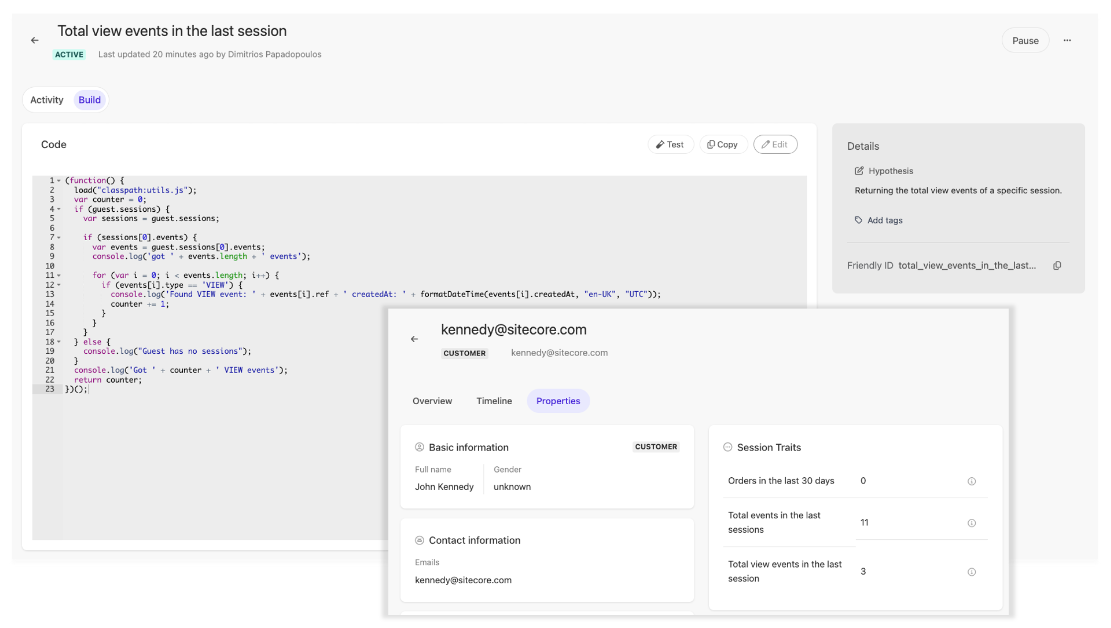
Session Traits could be used in CDP to:
- Enhance Audience Targeting: Filter segments for audience exports and activate targeted audiences outside of Sitecore CDP, for more targeted marketing efforts.
- Standardize Data Handling: Automatically calculate and store session traits after each session, ensuring consistent data usage and eliminating the repeated calculations.
Session Traits could be used in Personalize to:
- Personalize Experiences: Personalize content and product displays based on past behaviors or preferences. For example, you can highlight items previously viewed or liked, and avoid promoting products that have been dismissed, to create a more relevant and engaging experience.
- Support Informed Decision-Making: Implement business rules based on past purchases to showcase the next best offers, such as displaying merchandise in the customer’s size or favourite brands, to boost conversion rates.
There are some limitations associated with session traits you should be aware of these include:
- Session traits only apply to identified customers.
- Only “Web” and “Closed” sessions are eligible for trait calculations.
- Each tenant can create a maximum of ten session traits, and up to ten traits can be stored per customer profile.
- Traits are calculated only at the end of a session, based on recent session data, guest properties, recent orders, data extensions, and segment memberships.
- If a calculation fails, Sitecore CDP will retry up to ten times. Continuous failures (50 in an hour without success) will pause the trait automatically.
- Session trait values cannot be manually updated or modified through APIs.
- Each trait value in JSON format is capped at 10,000 characters.
Profile Traits
The main difference of Profile traits is they are available on CDP only, they are computed across all the data stored in the data lake which creates an aggregated view or aggregated data points that Sitecore CDP stores and persists in the Profile. These data points are very specific and defined by Sitecore. Some examples are shown in the work in progress UI below i.e. Total Spend, Average Spend, Total Orders etc.

This allows you to have OOTB data points that you can use in segmentation and decisioning (if you both CDP and Personalize) or create an audience export based on the profile trait values. Sitecore are hoping to add more data points over time.
Profile Sharing
Profile Sharing allows CDP to share guest profiles across the Sitecore suite of products in real time, a feature Sitecore is planning to release in 2025.
The first use case enables sharing profile data with Sitecore Search, so personalization in search results can reflect the most current user data:
- The Unified Identifier allows a profile push, enabling the profile to be shared with Sitecore Search.
- This provides Search with the most up-to-date traits and segments the guest belongs to.
- Allowing you to personalize search results based on the user profile, enhancing the personalization capabilities.
This will eventually be extended to include external systems via a webhook and Sitecore Connect, enhancing personalization efforts across digital experiences by pushing real-time customer data to where it marketers need it, allowing them to provide a more holistic user experience across all of their brands digital touchpoints.
Event Push
Even Push will enable the server-side mapping of events to external systems for example Google Analytics or Facebook Pixel. This reduces the need for multiple client-side tags and centralizes event management, reducing common issue of tag bloat. Set for release sometime in the later part of 2025.

Summary
Unified Tracking is the backbone to enabling all of these features.
- Enables sending events to multiple products: CDP, Personalize and Search.
- The shared identifier enables seamless Profile Sharing with Sitecore Search and Connect. With the integration with Connect you are then able to send that externally.
- Traits (session and profile) are incorporated into the shared profile that can then be shared with Sitecore Products and Externally.
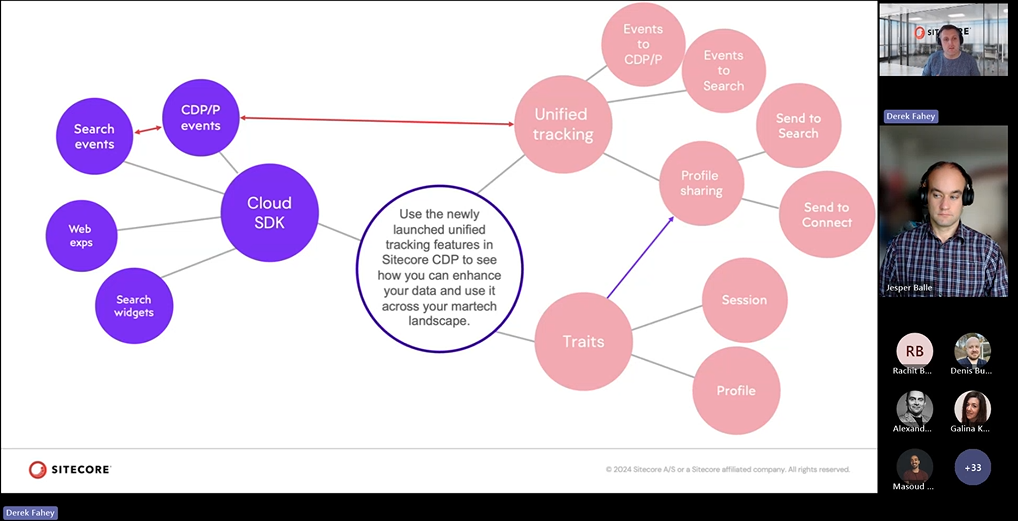
This is possible with Cloud SDK :
- Supports CDP and Personalize events and search events (e.g., search views, widget views, widget clicks, and page views).
- Future updates will expand commerce-side event support.
- Unified tracking is built into the latest version of the Cloud SDK, simplifying data integration.
- Web experiences functionality will be introduced in version 0.4 of the Cloud SDK, soon to be released.
- Search widgets and additional features from the Search SDK are now part of the Cloud SDK.
- Replaces the Engage library with feature-comparable capabilities. There is a comparison of current features here.
- Customers should be encouraged to transition to the Cloud SDK for integrating CDP, Personalize and XM Cloud.
Useful Info
Hope this was helpful!
 Neil Killen